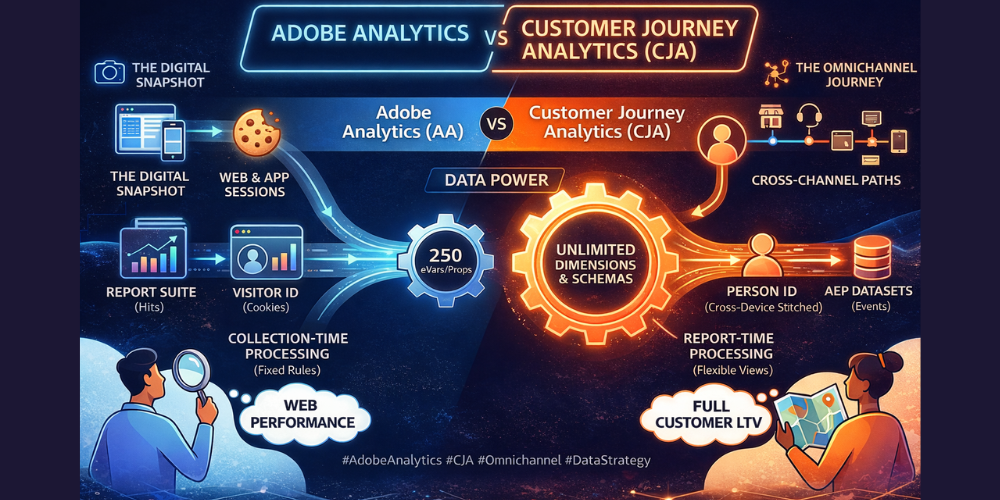
In the world of digital measurement, we are witnessing a generational shift. Is CJA just "AA on a newer server," or a fundamental reimagining of data?
In the world of digital measurement, we are currently witnessing a generational shift. For two decades, Adobe Analytics (AA) has been the gold standard for understanding how users interact with websites and mobile apps. It taught us about bounce rates, conversion funnels, and the "hit."
But today’s customer doesn't just exist in a browser. They browse on an app, call a support line, walk into a physical store, and receive an email—all in the same afternoon. This is where Customer Journey Analytics (CJA) enters the frame.
Is CJA just "AA on a newer server," or is it a fundamental reimagining of data? Let’s break down the showdown.
1. Data Foundation: Report Suites vs. Experience Platform
The most significant difference lies in "where" the data lives and "how" it gets there.
- Adobe Analytics (AA): Operates on Report Suites. Data is primarily collected via the AppMeasurement.js library. It is purpose-built for "web" logic (cookies, hits, and sessions). While you can upload offline data via Data Sources, it often feels like forcing a square peg into a round hole.
- Customer Journey Analytics (CJA): Sits on top of the Adobe Experience Platform (AEP). It doesn’t use report suites; it uses Data Views connected to Datasets. This means you can ingest data from anywhere—POS systems, CRM, call centers, or even snowflake schemas—provided it follows the XDM (Experience Data Model) format.
2. The Identity Revolution: Visitor ID vs. Person ID
How do these tools define "who" is doing the clicking?
| Feature | Adobe Analytics (AA) | Customer Journey Analytics (CJA) |
|---|---|---|
| Primary Identifier | ECID / Cookies | Namespace-based Person ID |
| Cross-Device | Limited (requires Cross-Device Analytics/CDA) | Native (Stitching via AEP) |
| Historical Data | Hard to "re-identify" old data | Can "replay" and restitch identities retroactively |
In AA, if a user clears their cookies, they are a stranger. In CJA, because data is tied to a Person ID (like an email or CRM ID) within AEP, you can stitch their past anonymous behavior to their known profile once they log in.
3. Processing Power: Collection-Time vs. Report-Time
This is the "secret sauce" that makes CJA a favorite for data architects.
- AA is "Collection-Time": Most logic (like Processing Rules or VISTA rules) is applied the moment the data hits the server. If you realize you tracked a variable wrong six months ago, you usually can't "fix" the historical data; you can only fix it moving forward.
- CJA is "Report-Time": Data is stored in its raw form. The logic is applied when you run the report. Don't like how a dimension was defined? Change the Data View settings, and the change reflects across all your historical data instantly.
4. Terminology: A New Language
If you're moving from AA to CJA, you’ll need to update your vocabulary:
- Hits are now Events.
- Visits are now Sessions (and they are much more configurable).
- Visitors are now People.
- eVars and Props are gone, replaced by Schema Fields (which have no "75-character limit" or "250-variable limit").
When Should You Make the Switch?
Stick with Adobe Analytics (AA) if:- Your business is 100% digital (web/app only).
- Your team is comfortable with the current implementation and doesn't have the resources to migrate to XDM schemas.
- You don't currently use or plan to use the Adobe Experience Platform.
- Omnichannel is your reality: You need to see how a call center interaction affects an online purchase.
- You need flexibility: You want to be able to change data logic (like session timeouts or attribution models) on the fly without re-tagging the site.
- You want more dimensions: You are tired of hitting the "limit" of eVars and want unlimited, descriptive data fields.
Deep Diving into the Architecture: Why the Shift Matters
To truly understand the divide between Adobe Analytics (AA) and Customer Journey Analytics (CJA), we have to look under the hood. While AA was built for the era of the "browser session," CJA was built for the era of the "big data ecosystem."
1. The Death of the "Persistence" Headache
In traditional Adobe Analytics, you spent a significant amount of time configuring Allocation and Expiration for eVars. Once a value was set, it "stuck" to the visitor based on the rules you defined at the time of collection.
- The AA Constraint: If you set an eVar to expire after 30 days, but later realized your sales cycle is actually 90 days, your historical data is essentially "stuck" with the 30-day logic.
- The CJA Solution: Since CJA uses Report-Time Processing, persistence is virtual. You can create one Data View where a "Campaign ID" persists for 24 hours, and another Data View where it persists for a lifetime. You are no longer locked into the decisions you made during implementation.
2. Unlimited Dimensions: Breaking the 250 Barrier
For years, AA power users played "Evar Tetris," trying to fit complex business data into a limited number of slots (props and eVars).
- In AA: You have 250 eVars. If you need 251, you're out of luck.
- In CJA: There is no concept of a "numbered" variable. If your schema has 1,000 fields—ranging from "Store Manager Name" to "Atmospheric Pressure at Time of Purchase"—CJA can ingest and report on all of them. This allows for High Cardinality data that AA historically struggled to process.
3. Metric Flexibility: Calculated Everything
CJA takes the "Calculated Metric" builder you love in AA and puts it on steroids.
- Session Customization: In AA, a session (visit) ends after 30 minutes of inactivity. Period. In CJA, you can define a session however you want. Want a session to end after 5 minutes for a fast-paced gaming app? Or 24 hours for a B2B portal? You can define this at the Data View level without changing a single line of code.
- Attribution on the Fly: You can change attribution models (First Touch, Last Touch, Algorithmic, Linear) in any table instantly. While Workspace in AA does this well, CJA's ability to apply these models across offline data makes it significantly more powerful.
4. Comparison of Data Governance
| Feature | Adobe Analytics (AA) | Customer Journey Analytics (CJA) |
|---|---|---|
| Data Correction | Requires "Data Repair API" (Complex) | Edit the Data View or re-ingest the Batch |
| Data Latency | 45–90 minutes (standard) | Varies based on AEP ingestion, but often near real-time |
| Anonymization | Controlled via obfuscation/IP masking | Built-in AEP Privacy & Governance (DULE) |
| Granularity | Summarized into "Visits/Visitors" | Event-level raw data access |
5. The "Stitching" Secret
The most "magical" part of CJA is Cross-Device Stitching. In AA, Cross-Device Analytics (CDA) was a heavy lift that often required a specific setup and had limitations on how far back it could look.
In CJA, the Stitching Service allows you to:
- Take an unauthenticated (anonymous) session from Monday.
- Recognize the user when they log in on Friday.
- Retroactively update Monday’s data to link it to that user’s ID.
This provides a continuous "Person" journey that transforms how you calculate Customer Acquisition Cost (CAC) and Lifetime Value (LTV).
6. Is it a Replacement or a Companion?
While Adobe positions CJA as the future, many enterprises are currently running Side-by-Side.
- The Hybrid Approach: Use AA for your day-to-day web "pulse" (real-time site monitoring) while using CJA for your deep-dive strategic analysis, cross-channel attribution, and long-term customer journey mapping.
Adobe Analytics is a specialized tool for digital analysts. Customer Journey Analytics is a strategic platform, a business intelligence powerhouse built for the modern, fragmented customer path for the entire business.
"If your goal is simply to see how many people clicked a button on your homepage, AA is more than enough. But if your goal is to understand how a 'Viewed Email' event led to a 'Store Visit' and ultimately a 'Refund via Call Center,' CJA is the only way to tell that story."
The transition isn't just about changing tools; it's about moving from a "page view" mindset to a "person-centric" strategy. If you're ready to see the full picture of your customer, the path leads to CJA.
Validated by MarTechRise Labs