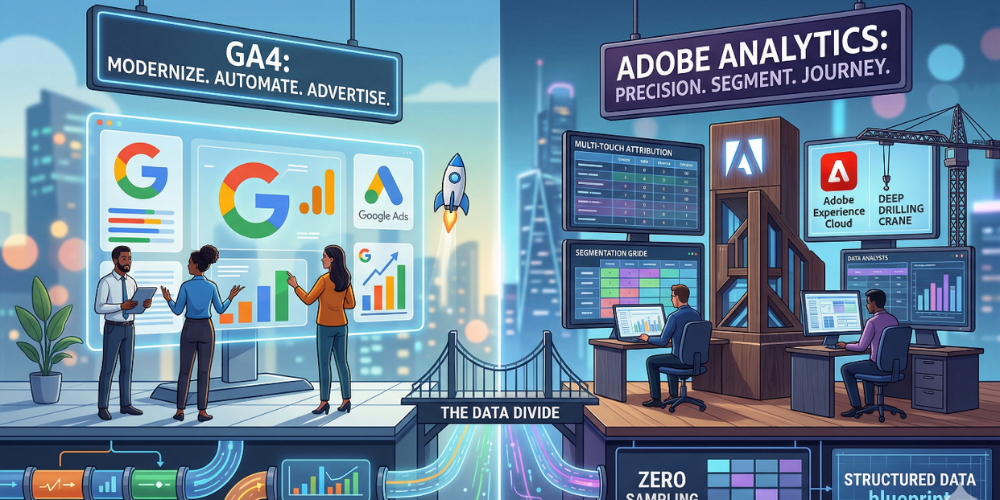
The biggest mistake people make is thinking these tools do the same thing. They don't. Here is the ultimate 2026 enterprise showdown.
1. The Core Philosophy
The biggest mistake people make is thinking these tools do the same thing. They don't.
| Feature | Google Analytics 4 (GA4) | Adobe Analytics (AA) |
|---|---|---|
| Identity | An Advertising tool. | An Analysis tool. |
| Logic | Event-based, automated, and AI-modeled. | Intentional, structured, and "100% human" data. |
| Best For | Marketing teams & Google Ads heavy-hitters. | Data scientists & complex multi-touch enterprises. |
2. Key Comparison Points for 2026
A. Data Accuracy & Sampling- GA4: Still relies on sampling for complex explorations. If your traffic is massive, GA4 "guesses" the remaining data based on a subset. To get raw data, you must export to BigQuery.
- Adobe: Zero sampling. Adobe processes 100% of your data, 100% of the time. For industries like Finance or Healthcare where 1% of data represents millions of dollars, this is the "killer feature."
- GA4 is "plug and play." With Enhanced Measurement, it automatically tracks scrolls, clicks, and downloads. It’s great for teams that want insights yesterday.
- Adobe is "measure twice, cut once." Nothing is tracked unless you define it (eVars, props, and success events). It takes months to set up, but the data is "cleaner" because it was built with a specific business blueprint.
- The Google Stack: If you live in Google Ads, Search Console, and YouTube, GA4 is unbeatable. The native integration allows for seamless audience sharing and ROAS (Return on Ad Spend) tracking.
- The Adobe Stack: If you use Adobe Experience Manager (AEM) for your CMS or Adobe Target for A/B testing, AA is the brain of that ecosystem. It allows for real-time personalization that GA4 struggles to match.
3. The "Hidden" Differences
Data Retention
In 2026, privacy is everything.
- GA4 limits user-level data retention to 14 months (standard) or 50 months (360 version).
- Adobe defaults to 25 months but can be extended to 10 years. If you need to see how a customer’s behavior changed over three years, GA4 alone won't help you.
The Learning Curve
- GA4 is designed for the "Modern Marketer"—intuitive, AI-driven, and simplified.
- Adobe Workspace is a "Data Scientist’s Sandbox." It’s a steep learning curve, but once mastered, the segmentation logic (e.g., "Users who did X, then Y, but never Z within 3 days") is far more powerful.
Here is the deep dive into the technicalities, the costs, and the final verdict for your business size.
Technical Implementation Differences
While both platforms are now fully event-based, the "how" of getting data into the system remains fundamentally different.
Google Analytics 4: The "Plug & Play" Model
- Automatic Tracking: GA4 uses Enhanced Measurement to automatically track events like scrolls, outbound clicks, site search, and video engagement without a single line of extra code.
- Identity Model: GA4 uses a "blended" identity approach, combining User ID, Google Signals (if enabled), and AI-driven behavioral modeling to fill gaps where users decline cookies.
- Implementation Speed: A basic setup takes 1–3 days. A full e-commerce implementation usually takes 2–4 weeks.
- Data Export: Relies heavily on the BigQuery Export for raw data access. Without BigQuery, your granular data is limited by GA4's 14-month retention cap.
Adobe Analytics: The "Blueprint" Model
- Intentional Tracking: Nothing is tracked by default. You must create a Solution Design Reference (SDR)—a massive spreadsheet mapping every business requirement to specific variables (eVars, Props, and Events).
- Data Processing Rules: Adobe allows you to rewrite data after it hits the server but before it’s stored. If a URL is messy, you can clean it up via the interface without changing site code.
- Implementation Speed: Expect 3–6 months. It requires a dedicated implementation engineer or a specialized agency.
- Data Integrity: Zero sampling. Adobe processes 100% of your data, making it the technical "Source of Truth" for high-compliance industries.
SMB vs. Enterprise
For SMBs (Small-to-Medium Businesses)
Winner: GA4 (Free Version)
- Why: SMBs rarely have the $50k+ budget or the full-time data analyst required to make Adobe Analytics useful. GA4 provides "80% of the value for 0% of the cost."
- Requirements: Basic conversion tracking, Google Ads integration, and user behavior summaries.
For Large Enterprises
Winner: It Depends on your "Stack"
- The Case for GA4 360: If your company is heavily invested in the Google Marketing Platform (Display & Video 360, Search Ads 360), the native integration is too powerful to ignore. It is the better choice for organizations that prioritize Marketing ROI and Attribution.
- The Case for Adobe Analytics: If you are a complex "Product-Led" company (e.g., a Bank, Airline, or Global Retailer) where data accuracy and long-term customer journey mapping are non-negotiable, Adobe is superior. It is the better choice for Deep Product Analysis and Retention Tracking.
The "Modern Hybrid" Approach
Many 2026 enterprises are now running both:
- GA4 for the marketing team to optimize ad spend.
- Adobe Analytics for the data science and product teams to analyze long-term user retention and lifetime value.
Which should you choose?
Choose GA4 if:
- You are a small-to-medium business or a marketing-heavy enterprise.
- Your primary goal is tracking conversions and ad performance.
- You want a "free" or lower-cost entry point into advanced analytics.
Choose Adobe Analytics if:
- You are a global enterprise with massive data volume.
- You require unsampled data for high-stakes decision-making.
- You have a dedicated data team to manage a complex implementation.
Validated by MarTechRise Labs