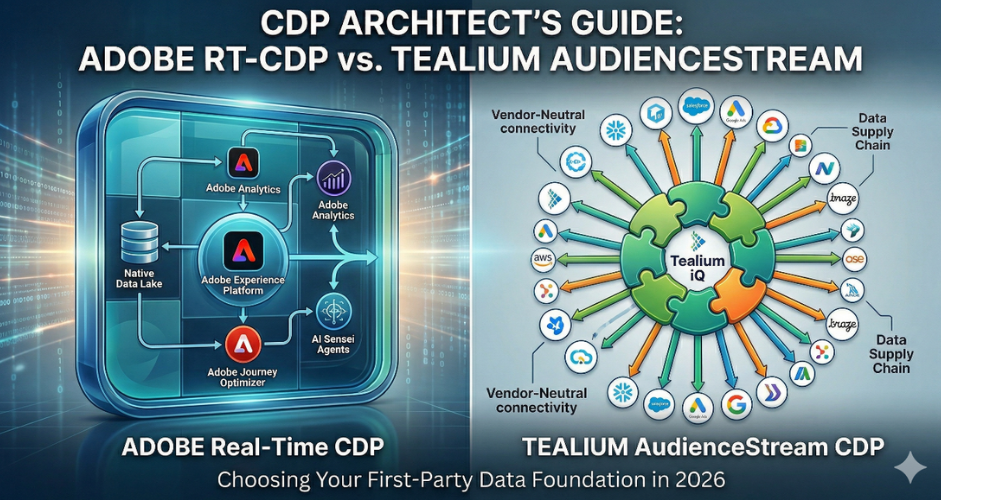
Choosing a Customer Data Platform (CDP) in 2026 is no longer about just "storing data"—it’s about how fast that data can power AI and real-time experiences.
Choosing a Customer Data Platform (CDP) in 2026 is no longer about just "storing data"—it’s about how fast that data can power AI and real-time experiences. While both Adobe and Tealium sit at the top of the enterprise market, they offer fundamentally different philosophies on how to handle customer identity.
Here is a breakdown of how Adobe Real-Time CDP and Tealium AudienceStream stack up today.
1. Adobe Real-Time CDP: The Ecosystem Powerhouse
Adobe’s CDP is built on the Adobe Experience Platform (AEP). It isn't just a standalone tool; it is the "brain" of the Adobe Experience Cloud.
Key Strengths:
- Native Ecosystem Integration: If your stack already includes Adobe Analytics, Target, or Journey Optimizer, the CDP acts as a seamless connective tissue.
- The "Edge" Advantage: Adobe uses its global Edge Network to process data in milliseconds. This allows for "next-hit" personalization—changing a website's layout the moment a user clicks, based on their updated profile.
- B2B + B2C Unity: Adobe is particularly strong at "Lead-to-Account" matching, making it a favorite for enterprise B2B companies that need to map individual behavior to corporate accounts.
- AI with Adobe Sensei: Integrated AI models help with predictive lead scoring and churn projection without requiring a separate data science team.
The Trade-off:
Adobe is an "all-in" solution. It is incredibly powerful but comes with a steeper learning curve and higher implementation costs. It works best when you are committed to the Adobe universe.
2. Tealium AudienceStream: The Neutral Integrator
Tealium’s approach is "vendor-neutral." It originated as a tag management system (Tealium iQ), meaning its DNA is rooted in the collection and delivery of data across thousands of different tools.
Key Strengths:
- Unrivaled Connectivity: Tealium boasts over 1,300+ pre-built integrations. It doesn't care if you use Google for ads, Braze for email, and AWS for your data warehouse—it connects them all effortlessly.
- Data Governance at the Source: Because Tealium often handles the initial data collection (via tags), it can catch data quality issues or privacy consent violations before the data even reaches the CDP.
- Agility & No-Code: Tealium’s interface is designed for "Customer Data Strategists" rather than just engineers. Marketers can build complex "badges" (attributes) and rules using a point-and-click UI.
- Flexible Architecture: In 2026, Tealium has leaned heavily into the "Composable CDP" trend, allowing you to stream data directly into Snowflake or BigQuery while maintaining real-time activation.
The Trade-off:
While Tealium is the "Swiss Army Knife" of data, it doesn't offer the deep, native execution tools (like native email or site optimization) that Adobe does. You still need to buy and manage the "destination" tools separately.
Comparison at a Glance
| Feature | Adobe Real-Time CDP | Tealium AudienceStream |
|---|---|---|
| Best For | Enterprises "all-in" on Adobe Cloud. | Best-of-breed stacks using many vendors. |
| Identity Resolution | Advanced; focused on "Identity Graphs." | Real-time; focused on "Event-to-Profile." |
| Implementation | Complex; usually requires a partner. | Faster; manageable by internal teams. |
| Speed | Excellent via Adobe Edge Network. | High-speed real-time event processing. |
| Cost | Premium; "Land and Expand" model. | Transparent; usage-based. |
The Deep Dive: 2026 Feature Showdown
The "table stakes" of 2025 have become the advanced features of today. Here is how they handle the cutting-edge requirements of 2026:
1. Technical Philosophy: Warehouse-Native vs. Hub-Centric
The most significant shift in 2026 is how these platforms interact with your "Source of Truth"—the Cloud Data Warehouse (Snowflake, BigQuery, Databricks).
Adobe: The Integrated "Visionary"
Adobe has moved toward a Federated Data Architecture.
- Zero-Copy Integration: Adobe now allows you to activate data directly from your data warehouse without copying the underlying datasets. This reduces storage costs and security risks.
- The AEP Foundation: Adobe RT-CDP is built on the Adobe Experience Platform. It uses a standardized data model (XDM), which is rigid to set up but incredibly powerful for scaling AI across the Adobe ecosystem.
Tealium: The Flexible "Challenger"
Tealium remains the king of Vendor Neutrality, but in 2026, it has pivoted toward the Composable CDP movement.
- Data Connect: Tealium’s newest "Data Connect" interface is a no-code canvas that lets you design data ingestion from CRMs (Salesforce/HubSpot) and Warehouses with drag-and-drop ease.
- Agnostic DNA: Tealium doesn't force a specific data model. It lets you define "Attributes" and "Badges" based on your specific business language, not a pre-defined schema.
2. AI & Collaboration
Adobe: AI Agents & Data Clean Rooms
- Data Engineering Agent: Adobe recently introduced an AI agent that automates SQL preparation and data onboarding, significantly lowering the "technical tax" of setting up the platform.
- RT-CDP Collaboration: This is Adobe’s answer to privacy-safe data sharing. It allows brands and publishers (e.g., a CPG brand and a Retailer) to match audiences in a secure Data Clean Room without ever exchanging raw PII (Personally Identifiable Information).
Tealium: Predict ML & Consent Orchestration
- Tealium Predict ML: While Adobe relies on the "Sensei" black box, Tealium offers a more accessible machine learning layer. Marketers can create likelihood-to-purchase or churn scores and inject them directly into the visitor profile in real-time.
- Consent at the Source: Tealium’s greatest edge is its integrated Consent Management. Because it sits at the "edge" (the tag layer), it can stop data collection for a specific user the moment they opt out, ensuring 100% compliance before the data even enters the CDP.
3. Comparison of Core Capabilities
| Capability | Adobe Real-Time CDP | Tealium AudienceStream |
|---|---|---|
| Identity Resolution | Identity Graph: Deep, patented stitching using Adobe's proprietary ID service. | Visitor Stitching: Highly configurable, transparent rules for linking devices to users. |
| Speed to Action | Sub-200ms: Optimized for "in-the-moment" personalization via Adobe Edge. | Real-Time Event Stream: Instant triggers across 1,300+ third-party connectors. |
| Data Governance | DULE Framework: Attribute-level policy enforcement (extremely robust). | Global Privacy: Geo-based data management and full-stack consent orchestration. |
| Market Segment | Focused on massive, centralized global enterprises. | Focused on agile, multi-vendor, best-of-breed organizations. |
4. The Implementation Reality (The "Hidden" Costs)
The Adobe "Platformization" Tax
Adobe’s power comes at the cost of complexity. To get the most out of RT-CDP, you often need Adobe Journey Optimizer (AJO) for orchestration and Customer Journey Analytics (CJA) for reporting. It is an "ecosystem play." Implementation typically takes 6–12 months and requires specialized consultants.
The Tealium "Agility" Advantage
Tealium is generally faster to deploy. A standard deployment of the Universal Data Hub can be live in 90 days. Because it is a no-code interface, your internal marketing operations team can often manage it without a dedicated army of data engineers.
Which Path Should You Choose?
Choose Adobe Real-Time CDP if:You are already an Adobe shop. If your teams live in Adobe Analytics and Target, adding the CDP will provide a level of synergy that is hard to beat. It is the "Gold Standard" for organizations that want a centralized, highly controlled, and incredibly deep personalization engine.
Choose Tealium AudienceStream if:You want to avoid vendor lock-in. If you want the freedom to swap out your email provider or your analytics tool next year without rebuilding your entire data infrastructure, Tealium provides that insurance. It is the most robust "neutral" player in the game, focusing on data quality and instant activation across the widest possible array of partners.
The 2026 Reality: Why not both?
Interestingly, many of the world's largest brands are no longer choosing one over the other. They use Tealium as their "Data Collection" layer to ensure clean, compliant data is fed into their Adobe "Experience" layer for high-end orchestration.
Validated by MarTechRise Labs